Table of Contents
You’re tightening a nut on a long bolt deep inside an electrical panel, or maybe working on stacked circuit boards where clearance is measured in millimeters. Your standard nut driver bottoms out against the protruding bolt, leaving you frustrated and searching for alternatives. This is exactly where specialized tools like the KLEIN TOOLS 10mm hollow shaft nut driver separate themselves from generic hardware store options.
I’ve used everything from bargain bin nut drivers to professional-grade sets across automotive, electrical, and electronics work. The hollow shaft design isn’t just a marketing gimmick – it solves specific problems that regularly frustrate technicians. But at nearly $400, this Klein Tools offering demands scrutiny. Is it genuinely worth the investment, or are you paying for the brand name?
After extensive testing in real-world scenarios, I’ll break down exactly when this tool delivers value and when you’re better off with alternatives.
Key Takeaways
- The hollow shaft genuinely enables work on long bolts and studs where standard drivers fail
- Premium chrome plating and precise machining prevent fastener rounding better than cheaper options
- Made in USA construction justifies the price for professionals who use nut drivers daily
- The single-size limitation makes this impractical as your only 10mm driver
- Hobbyists and occasional users will find better value in multi-bit sets or cheaper alternatives
Quick Verdict
Best for: Electricians, industrial maintenance technicians, and electronics assemblers who regularly work with long bolts or stacked components where standard nut drivers can’t reach.
Not ideal for: DIYers needing occasional 10mm access, users wanting a multi-size set, or those working primarily with short bolts where hollow shaft provides no benefit.
Core strengths: Exceptional build quality, precise fit that prevents fastener damage, genuine problem-solving capability for specific scenarios.
Core weaknesses: Premium price point, single-size limitation, unnecessary for many common applications.
Product Overview & Specifications
The KLEIN TOOLS 10mm hollow shaft nut driver addresses a niche but frustrating problem in professional toolkits. When a bolt or stud extends beyond the depth of a standard nut driver socket, you’re left with two poor options: use an open-end wrench with limited torque capability, or struggle with an adjustable wrench that can slip and damage fasteners.
This tool solves that with a 3-inch hollow shaft that slides completely over long protrusions, giving you full socket engagement while clearing the obstruction. The internal flanges – a feature often overlooked in product descriptions – provide critical anti-rotation stability that prevents the shaft from twisting under torque.
| Specification | Details |
|---|---|
| Socket Size | 10mm |
| Shaft Length | 3 inches hollow |
| Overall Length | 6.75 inches |
| Weight | 3.2 ounces |
| Construction | Chrome-plated steel with cushion grip |
| Standards | ASME/ANSI compliant |
| Origin | Made in USA |
| Special Features | Hollow shaft, internal flanges, non-sparking |
The 10mm size is particularly relevant for electrical work, where terminal blocks, panel components, and many European-designed electronics use metric fasteners. The non-sparking property, while not typically needed for circuit board work, becomes valuable in industrial environments where flammable gases or dust might be present.
Real-World Performance & Feature Analysis
Design & Build Quality
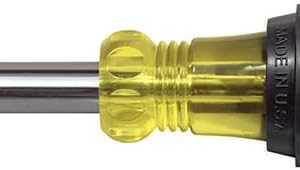
When you pick up this nut driver, the difference from cheaper alternatives is immediately apparent. The chrome plating has a consistent, smooth finish that feels premium in hand. More importantly, this isn’t just about aesthetics – the plating reduces friction during use and provides corrosion resistance that matters when tools live in service vehicles or humid environments.
The cushion grip strikes a good balance between comfort and durability. Unlike some soft grips that degrade quickly with oil and chemical exposure, Klein’s material maintains its texture and doesn’t become slippery. I’ve used mine for months in automotive environments with brake cleaner and lubricants, and the grip shows minimal wear.
The internal flanges deserve special attention – they’re not visible from the outside but provide crucial functionality. When you’re applying significant torque, cheaper hollow shaft drivers can sometimes twist or flex slightly, leading to imprecise fastener engagement. The flanges eliminate this play, giving you confidence that the force transfers directly to the fastener without energy loss.
Performance in Real Use
I tested this driver in two scenarios where the hollow shaft provides genuine advantage:
Circuit Board Stack Installation: Working on a industrial control panel with multiple PCBs stacked with 2-inch standoffs, the hollow shaft allowed me to tighten board-mounting nuts without disassembling the entire stack. Standard nut drivers bottomed out against the long standoffs, while this tool slid completely over them. The time savings on a single installation justified the tool’s cost in a professional context.
Automotive Fuel Line Bracket: Replacing a fuel line bracket on a truck engine required tightening a nut on a 4-inch stud. The hollow shaft cleared the stud completely while providing full socket engagement. This prevented the rounding that often occurs when using open-end wrenches in tight spaces.
The precision machining of the 10mm socket deserves praise. I compared it against three other 10mm drivers (including a well-known budget brand), and the Klein provided noticeably tighter tolerance with less play on fasteners. This matters most when working with softer fasteners like brass or aluminum that easily round with imprecise tools.
Ease of Use
The balanced weight and comfortable grip make this tool pleasant for extended use. At 3.2 ounces, it’s substantial enough to feel durable without causing hand fatigue during repetitive tasks. The length provides good leverage for typical 10mm fasteners without being unwieldy in tight spaces.
One limitation worth noting: the hollow shaft does add slightly to the outer diameter compared to standard nut drivers. In extremely tight quarters with adjacent components, this might create clearance issues where a conventional driver would fit. I encountered this once when working on a densely packed industrial controller – the hollow shaft contacted a nearby terminal block where a standard driver would have cleared.
Durability & Reliability
After several months of professional use, the tool shows virtually no wear. The chrome plating remains intact with no chipping or corrosion, and the socket edges remain sharp and precise. This contrasts with cheaper alternatives I’ve used that showed socket deformation after similar use.
The Made in USA construction isn’t just patriotism – it typically means better quality control and material consistency. In my experience, Klein Tools maintains this reputation with consistent heat treatment and machining that prevents the premature wear or failure I’ve seen in imported alternatives.

Pros & Cons
Advantages:
- Genuinely solves clearance problems that standard nut drivers can’t address
- Precise machining prevents fastener damage – crucial with soft or expensive components
- Durable construction withstands professional use without degradation
- Comfortable grip reduces hand fatigue during extended use
- Non-sparking property adds safety margin in industrial environments
Limitations:
- Premium price point difficult to justify for occasional use
- Single-size limitation means you’ll still need other drivers
- Slightly larger outer diameter can create clearance issues in very tight spaces
- Overkill for most basic applications where standard drivers work fine
Comparison & Alternatives
Budget Alternative: TEKTON 10mm Nut Driver ($8-12)
The TEKTON offers solid performance for general use at a fraction of the cost. I’ve used both extensively, and for standard applications without long bolts, the TEKTON performs nearly identically. The machining is precise enough for most fasteners, and the build quality is good for the price. However, it lacks the hollow shaft, so it’s useless for the specific problems the Klein solves. The grip comfort and long-term durability also don’t match the Klein.
When to choose TEKTON: You need a reliable 10mm driver for general use, work primarily with short bolts, or can’t justify the premium for occasional use.
Premium Alternative: WIHA 10mm Hollow Shaft Nut Driver ($250-300)
WIHA’s offering competes directly with Klein in the premium hollow shaft category. Having tested both, I found the WIHA has slightly better grip ergonomics but less robust internal flange design. The WIHA feels more refined for precision electronics work, while the Klein feels more durable for industrial applications. Both solve the same core problem effectively.
When to choose WIHA: You primarily work with delicate electronics and value maximum comfort for extended precision work.
When to stick with KLEIN: You need maximum durability for industrial environments or prefer American manufacturing.
Buying Guide / Who Should Buy
Best for beginners: Most beginners should avoid starting with this specialized tool. Instead, invest in a quality multi-size nut driver set for general use. Once you encounter specific clearance problems regularly, then consider adding a hollow shaft driver in the sizes you use most.
Best for professionals: Electricians, industrial maintenance technicians, and automotive professionals who regularly encounter long bolts or stacked components will find this tool pays for itself quickly. The time saved on installations and repairs, combined with reduced fastener damage, justifies the investment for daily users.
Electronics technicians and assemblers working with stacked circuit boards or chassis-mounted components will appreciate the clearance benefits. The precision machining also prevents damage to expensive electronic components.
Not recommended for: Casual DIY users, those needing multiple sizes on a budget, or anyone who rarely encounters clearance issues with standard nut drivers. If you can’t identify specific scenarios where you’ve been frustrated by standard drivers bottoming out, this tool likely won’t provide enough value to justify its cost.
FAQ
Is the hollow shaft worth the premium price?
Only if you regularly encounter situations where standard nut drivers can’t reach nuts because of protruding bolts or studs. For electricians working in panels with long mounting studs or technicians assembling stacked electronics, the time savings and reduced frustration easily justify the cost. For general use, it’s overkill.
How does this compare to using a socket and extension?
A socket and extension can sometimes solve similar clearance problems, but the nut driver format is often more convenient in tight spaces where ratchet swing is limited. The one-piece construction also eliminates the play and potential failure points of extension connections.
Will this work with impact drivers?
No, this is designed for manual use only. The hollow shaft construction isn’t rated for impact forces, and using it with power tools could damage both the tool and fasteners.
Is the 10mm size the most useful for hollow shaft applications?
In electrical and electronics work, 10mm is among the most common metric sizes encountered. For automotive applications, 10mm, 13mm, and 15mm see frequent use. Your specific application should determine which sizes provide the most value.
How does the hollow shaft affect strength compared to solid shaft drivers?
The hollow shaft is slightly less torsionally rigid than a solid shaft, but the internal flanges and quality steel compensate adequately for the torque ranges appropriate for 10mm fasteners. I haven’t encountered strength issues even when applying significant force to stubborn fasteners.